
The Role of Puppy Classes in Socialization

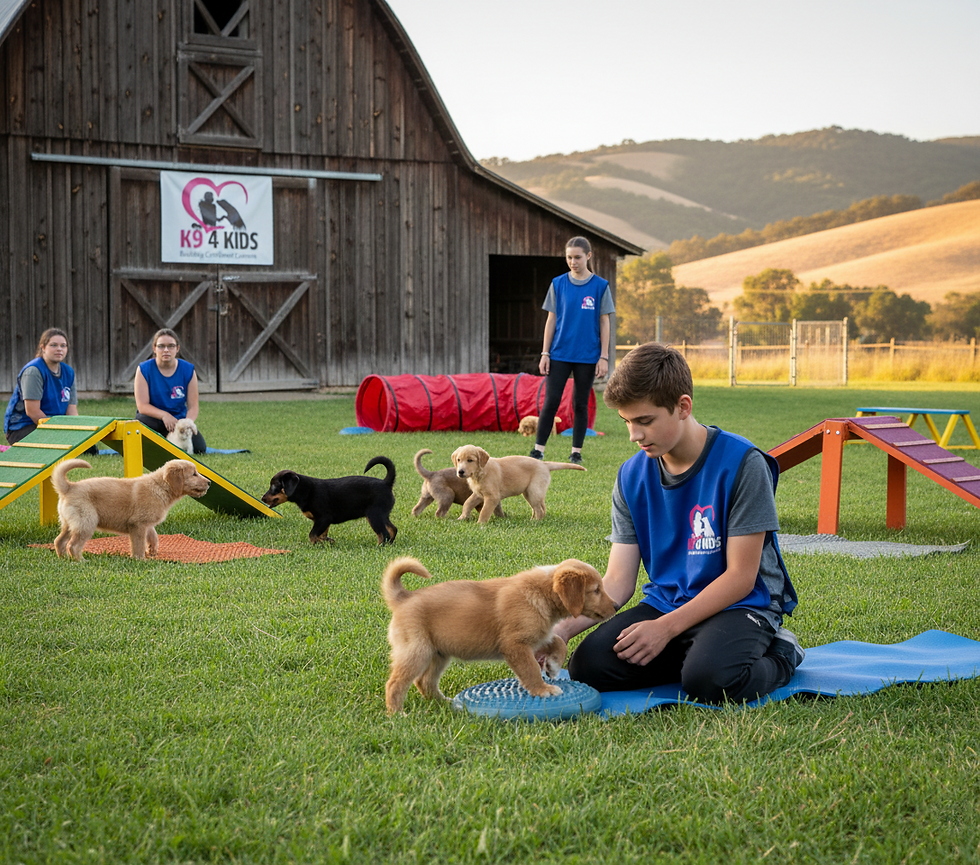
The first fourteen weeks of life define a dog's future. This short period dictates whether a puppy grows into a confident family companion or a fearful liability. Behavioral problems are the number one cause of death for dogs under three years of age. These issues rarely stem from genetics alone. They stem from a lack of early, structured exposure to the world.
Owners often wait too long to begin training. They believe they must wait until six months of age or until full vaccination is complete. This delay is a mistake. The window for primary socialization closes by sixteen weeks. Once it shuts, fear takes root. K9 4 KIDS provides the structured environment necessary to navigate this critical phase safely. We do not simply train dogs. We build resilient temperaments through a unique model that integrates rescue work with youth mentorship in San Martin and the South Bay Area.
Understanding the 3-to-14 Week Timeline
A puppy's brain remains uniquely receptive to new stimuli until approximately fourteen weeks of age. During this time, they categorize new experiences as "safe" or "normal." After this biological window closes, the brain creates a fear response to the unknown. This survival mechanism works well for wolves in the wild. It works poorly for family dogs living in human society.
Quantity vs. Quality of Exposure
Socialization is not about throwing a puppy into a chaotic crowd. It is about positive, controlled interactions. The Cummings School of Veterinary Medicine at Tufts University emphasizes that the quality of exposure matters more than the quantity. A puppy overwhelmed by twenty screaming children learns to fear children. A puppy introduced to one calm child learns trust.
We prioritize these positive associations. We control the environment to ensure the puppy wins every interaction. They learn that novelty predicts rewards, not danger.
Risks of Delayed Socialization
Isolation leads to behavioral deficits. A "wait and see" approach creates permanent anxiety. Recent studies from the National Institutes of Health (NIH) analyzing canine behavior found that puppies isolated past eight weeks demonstrate significantly higher fear metrics. These dogs struggle to adapt to new environments later in life. They bark at strangers. They snap when handled. They suffer from separation anxiety.
You prevent these outcomes by starting puppy socialization classes in San Martin CA immediately upon adoption. The cost of prevention is a fraction of the cost of rehabilitation.
Safety First: Addressing Vaccination Concerns
A common objection stops many owners from seeking training. They worry about parvo or distemper. They ask if it is safe to socialize a puppy before all shots are complete. The answer is yes, provided you choose the right environment.
The AVSAB Position Statement
The veterinary community has shifted its stance based on mortality data. The American Veterinary Society of Animal Behavior (AVSAB) states clearly that the standard of care for puppies seven to eight weeks of age includes socialization classes. They argue that the risk of behavior problems outweighs the risk of infection in properly managed classes.
Infectious diseases are serious. However, behavioral euthanasia kills more dogs than infectious diseases in the United States. We mitigate disease risk through strict sanitation protocols. Our facility requires all entering puppies to have at least one set of age-appropriate vaccinations and deworming. This creates a herd immunity bubble that public spaces like dog parks or sidewalks do not offer.
Socializing Rescue Puppies and Adoptees
Rescue dogs face higher stakes. A puppy from a responsible breeder likely received handling from birth. A rescue puppy might have started life in a storm drain, a hoarding situation, or a noisy shelter. They often lack early neural mapping for human touch or household sounds.
The Rehabilitation Mindset
For rescue adopters, socialization acts as rehabilitation. You must overwrite early negative data with new positive data. We serve the South Bay Area with programs designed to reset these fearful responses. We teach owners how to read subtle body language. You learn when your dog is over threshold. You learn how to advocate for them.
Addressing Fear in Big Dog Rescues
Fear manifests differently depending on the dog's size. A frightened small dog might hide. A frightened Rottweiler or Shepherd might lunge. Owners of powerful breeds bear a higher responsibility to ensure public safety. A large dog must be bombproof in public to avoid liability.
Our Big Dog Rescue programs focus heavily on confidence building. We expose these dogs to agility equipment, unstable surfaces, and strange objects. When a large dog conquers a physical obstacle, they gain internal confidence. A confident dog does not feel the need to act aggressively to protect itself.
The K9 4 KIDS Difference: Youth and Community
Most dog training centers focus solely on the dog. We focus on the connection between the dog and the community. Our mission pairs rescue dogs with youth who face their own challenges. This symbiotic relationship accelerates learning for both parties.
Building Confidence: The Youth-Canine Connection
Puppies need exposure to children to become safe family pets. Children move erratically. They make high-pitched noises. A dog that is not socialized to children views them as prey or threats. Our classes often integrate supervised interactions with youth participants.
This provides the puppy with safe exposure to children. It teaches the dog that small humans are sources of food and leadership. It prevents future bite incidents.
How Training Teaches Leadership
This interaction serves the child as well. When we work on Interacting Challenged or Troubled Youth with Dogs, we see immediate changes in the child's demeanor. The child must be calm to get the dog to sit. They must be clear to get the dog to stay.
The dog acts as a biofeedback mirror. If the child is angry, the dog disconnects. If the child is grounded, the dog engages. This teaches the youth emotional regulation and leadership without a lecture. You support this life-changing work when you enroll your own puppy in our classes.
Curriculum: What a Good Class Looks Like
Effective puppy training classes near me must go beyond "sit" and "down." Obedience commands are useful, but they do not change how a dog feels about the world. Our curriculum focuses on emotional neutrality and environmental stability.
Beyond Sit and Stay: Real-World Exposure
We simulate the real world in a controlled setting. We use:
Handling Exercises: We touch paws, ears, and tails to prepare puppies for vet visits and grooming.
Surface Exposure: Puppies walk on tarps, metal grates, and wobble boards. This builds proprioception and confidence.
Sound Desensitization: We play recordings of thunder, fireworks, and sirens at low volumes, gradually increasing intensity as the puppies eat high-value treats.
Training for South County Environments
San Martin and San Benito County present specific challenges. A dog here encounters horses, tractors, livestock, and wildlife. A city dog might never see a horse. A South County dog sees them weekly.
We include exposure protocols relevant to our rural and semi-rural environment. We teach puppies impulse control around motion. We teach them that a horse is not a giant dog to play with. This specificity prevents tragic accidents on local trails and ranches.
Puppy Classes, The ROI of Early Training
Training is an investment. The upfront cost of a puppy class pales in comparison to the long-term costs of a behaviorally unsound dog.
Prevention vs. Correction: The Cost of Waiting
Correcting established aggression is difficult and expensive. Board-and-train rehabilitation programs for aggressive dogs cost thousands of dollars. Even with that investment, success is never guaranteed.
A 2024 study published in Animals noted that owners who attended puppy classes reported significantly better relationships with their dogs. They were less likely to surrender the dog to a shelter. You are buying fifteen years of peace. You are ensuring you can take your dog on vacation. You are ensuring your dog is safe around your grandchildren.
Building a Bond That Lasts
Training establishes a language. It teaches the dog that you are the source of guidance. When a dog looks to you for direction in a stressful moment, you have succeeded. This bond prevents dogs from running away. It prevents them from chasing deer. It keeps them safe.
Research reinforces that the human-animal bond correlates directly with the amount of shared activity. Training is the highest form of shared activity. It is mental work. It exhausts a puppy faster than a physical walk. A tired puppy is a good puppy.
Conclusion: K9 4 KIDS Provides All the Training For Your Puppy To Thrive

You have a short time to get this right. The biology of your puppy's brain dictates the schedule. Do not let the window close without action. Proper socialization prevents heartbreak. It builds a dog that is a joy to live with rather than a source of stress.
K9 4 KIDS stands ready to help. We offer the expertise, the facility, and the community support you need. Contact K9 4 KIDS today to check our current class schedule and enroll your puppy. Give them the start they deserve.


Comments